
E-Invoicing Services in Dubai, UAE

The Electronic Invoicing System of the United Arab Emirates is not something you should consider planning for “later,” not anymore. The pilot & voluntary phase started on the 1st of July, 2026, and the first compulsory deadline is dated 1st January, 2027. From that particular date, business entities in scope can no longer officially issue a PDF-type invoice and fulfill compliance – invoices need to be made as structured XML. Moreover, they need to get exchanged via an Accredited Service Provider, and officially reported to the FTA. 

Xpert Tax & Accounting aids business entities across Dubai as well as the wider UAE get prepared. We evaluate where both your invoicing as well as master data stand currently, help you shortlist as well as formally appoint an ASP, guide you navigate the EmaraTax onboarding, coordinate the complex integration with the help of your accounting/ERP system, and support you through the testing phase and go-live stage.

Xpert Tax:

Xpert Tax & Accounting

Schedule a Free 30-Minute Consultation Call

Lead Gen

By submitting this form you agree to our Privacy Policy. We will contact you via email or phone for scheduling or marketing purposes.

Understanding What is the UAE E-Invoicing System

E-invoicing in the United Arab Emirates refers to the issuing and exchanging of invoices as structured, machine-readable forms of data as opposed to documents an individual reads. A PDF file, a scanned copy, a document or Word file, or an e-mailed picture is no longer considered an e-invoice as per the new framework, irrespective of how it gets delivered. 

The new system operates on the Peppol network with the help of a Decentralised Continuous Transaction Control and Exchange model – also referred to as the five-corner model. As opposed to each invoice going through one government portal, invoices now will move between numerous accredited providers, with the tax-related data reported to the Federal Tax Authority in almost real time. 

The detailed framework is mentioned in Ministerial Decision Number 243 of 2025 on the Electronic Invoicing System and the Ministerial Number 244 of 2025 on its implementation, officially issued as per Federal Decree Law Number 8 of 2017 on VAT. The Ministerial Decision Number 244 has since then been amended or changed by Ministerial Decision Number 66 of 2026. Cabinet Decision Number 100 of 2025 amended the VAT Executive Regulations for aligning the mentioned mandate. Moreover, the UAE Ministry of Finance officially published its Electronic Invoicing Guidelines, with the Version 1.1 having been issued in June 2026. 

Which Particular Transactions Are in Scope? 

The mandate is applicable to B2B (Business-to-business) as well as to B2G (Business-to-government) transactions. B2C (Business-to-consumers) sales sit outside of the scope for now, although this might get changed at a later stage. 

A variety of activities are explicitly excluded, such as sovereign activities of government bodies that are not competition with the private sector, certain international passenger, as well as transport services of goods provided by airlines, and specific exempt financial services. If you are not sure about whether a certain stream of revenue is caught, that is something worth confirming prior to committing to an implementation plan.


Corporate Tax Assessment, in simple words, can be defined as the systematic procedure of considering suggestions for business entities, where there is room to implement relevant changes both within as well as outside of the overall business unit or group. 

The eventual outcome of an assessment is establishing a solid base for efficient tax planning, business reconstruction, and performing the required compliance verifications.Now that you understand what Corporate Tax Assessment is, let us take a closer look at what Corporate Tax Impact Assessment Is.

What is UAE Corporate Tax Impact Assessment?

The Deadlines of UAE E-Invoicing: Which Phase is Applicable For You

Your dates of compliance are dependent on your official revenue in the most recent taxable year. Every phase has 2 distinct deadlines – one to formally appoint an ASP, and a later one for actually going live. 
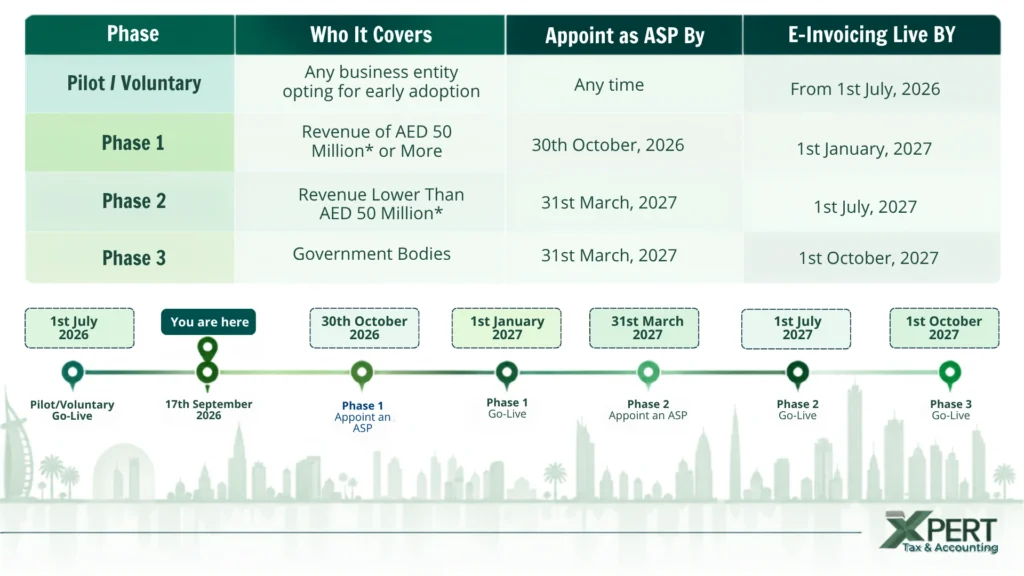
The original deadline of Phase 1 ASP was 31st July, 2026, originally. It has now been extended to 30th October, 2026. Note that the go-live data of 1st January, 2027, did not move. Treat this extension as a preparation period and not as a sign of the mandate of slipping.

How the Five-Corner Model Functions

Understanding the flow properly makes it much more clearer why this is deemed a systems project and not a change of formatting.
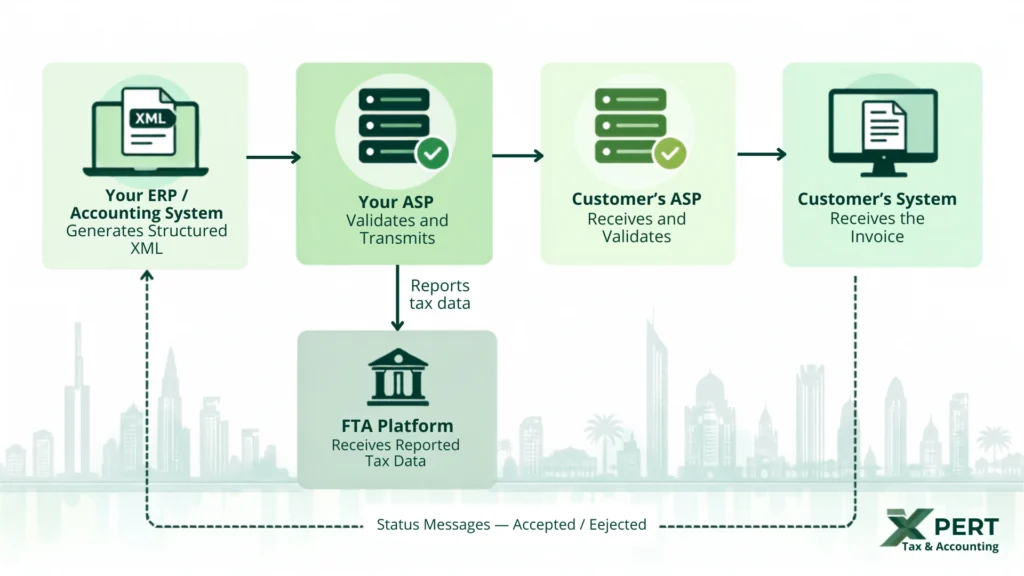
 

Corner 1 -

Your accounting/ERP system generates the invoice in the form of structured XML.

Corner 2 -

Your ASP authenticates the invoice against the requirements of the UAE and then transmits it.

Corner 3 -

The ASP of your customer receives as well as validates the official invoice on their behalf.

Corner 4 -

The system of your customer gets the authenticated or validated invoice.

Corner 5 -

The central platform of the Federal Tax Authority gets the reported tax data. 

Status messages go back via the network at every stage for confirming whether an invoice got accepted or rejected. In simpler words, invoice “sent” can still be unsuccessful in validation downstream. Moreover, a finance team member needs to know what needs to be done when it happens. 

What a Compliant E-Invoice in UAE Must Have

Invoices must get issued in the format of PINT AE – the United Arab Emirates’ national implementation of the specification of Peppol International Invoice, made on UBL 2.1. The compulsory fields specification of the FTA sets out the complete data set needed across various invoice scenarios, and it is much more demanding than the majority of business entities assume. 

The practical execution of this is that your invoice data needs to be 100% complete and free-of-errors prior to reaching your ASP. The following two things lead to the majority of trouble in practice: 

  • Your TIN (Tax Identification Number): Your network’s participant identifier needs to be directly derived from your Tax Identification Number, which is the first 10 digits of your official corporate tax registration number. Business entities that are not required to officially register for UAE Corporate Tax are still required to register with the Federal Tax Authority to get one. 


  • Customer & Supplier Master Data: Missing Tax Registration Numbers, legal names that are not consistent, outdated addresses, as well as incomplete records of contacts will lead to validation failures at scale post the automatic moving of invoices. 

This is the specific project part that benefits the most from getting started early, since it is deemed cleanup of data as opposed to software configuration, and it generally sits with your team of finance and not your IT vendor. 

Three Steps to Compliance: All You Need to Know
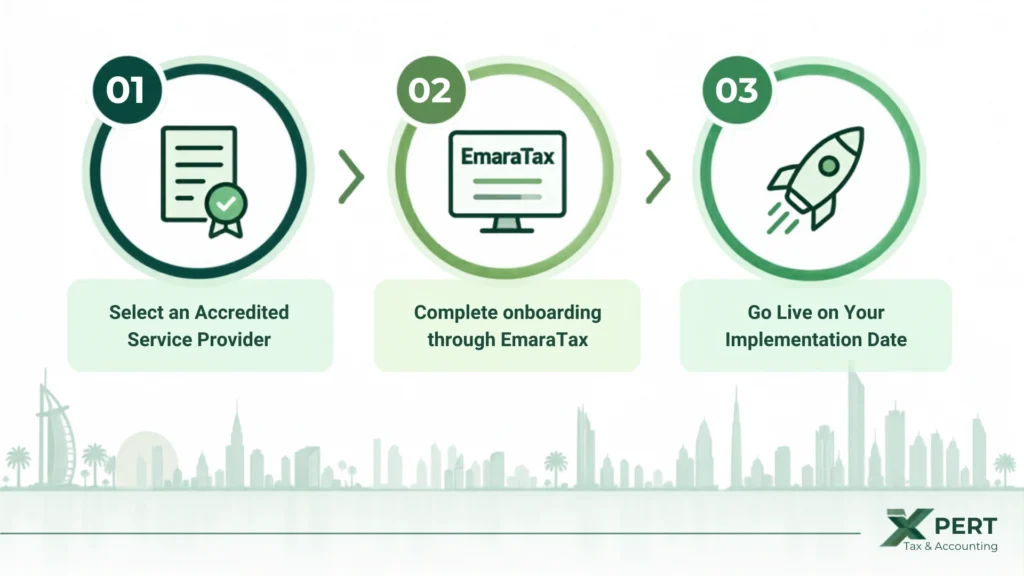
 
  • Choose a Service Provider Who is Accredited: Opt for a provider from the UAE’s Ministry of Finance list and place a commercial agreement in place. Every business appoints one ASP to manage both outgoing as well as incoming invoices.


  • Complete Your Onboarding Via EmaraTax: Onboarding gets started from your end through the EmaraTax of the Federal Tax Authority’s portal, and not by the ASP. You log in to the portal, open the e-invoicing section, choose your desired provider, and visit their platform for completing the procedure. Once the onboarding gets finished, your specific Peppol participant identifier gets registered on the network. 


  • Go Live on Your Date of Implementation: Your ERP or system of accounting must remain connected, your data fully mapped, your invoices properly tested, and most importantly, your team trained prior to the date that applies to your specific phase. 

Penalties & Fines for Non-Compliance

Cabinet Decision Number 106 of 2025 establishes the administrative fines attached to the E-invoicing system. These include a monthly fine for failing to comply fully with the e-invoicing obligations, a per-invoice fine for invoices that do not get transmitted through the system, as well as a per-day fine for failing to formally notify the Federal Tax Authority of a system-related malfunction. 

Business entities that adopt e-invoicing voluntarily before their compulsory date do not get exposed to the said penalties during the voluntary period. That is deemed the strongest practical argument for moving early; you find all your errors while the mistakes are still free. 

The commercial threat is also worth naming. Once all your customers are live, an invoice that does not successfully pass validation is deemed an invoice that has not been delivered – and one that will not get cleared or paid on-time. 

Our Comprehensive E-Invoicing Services in the United Arab Emirates

E-Invoice Readiness Evaluation

We fully review how you invoice today – the specific systems you utilize, your volumes as well as scenarios associated with your invoice, customer and supplier data’s quality, and most importantly, which of your business’ revenue streams fall within the mandate. You get a written report of readiness setting out all your gaps against the requirements of PINT AE as well as a sequenced plan along with dates. For the majority of businesses, this is deemed the correct first step, primarily because it dictates how major the project actually is prior to the budget-commitment part. 

Selection of ASP & Appointment Support

The list of the UAE’s Ministry of Finance is growing, and the headline pricing is deemed the least useful avenue to select between providers. We aid you in comparing options on the important things, i.e., the things that matter: whether they integrate very clearly with your particular accounting/ERP platform, how long their official queue of onboarding is, how they manage numerous entities under a single group, what their arrangement of support appears like once you are live, and how their specific pricing behaves as the volumes of invoice grow. 

Onboarding Support for EmaraTax

We guide you through the entire process of appointment in EmaraTax, including double-checking and confirming your TIN, inspecting that your UAE trade license and entity details are current within the portal before you begin, and ensuring the appointment gets submitted against the right legal entity where a group holds numerous registrations. 

ERP & Accounting System Integration

Depending on the ERP or accounting tool you use, we coordinate the technical task of connecting your system to your specific ASP: mapping the fields of your invoice to the needed structure, configuring how the credit notes as well as corrections are managed, and ensuring the confirmation of what leaves your system will successfully pass validation. 

Master Data & Invoice Data Cleanup

We evaluate your customer as well as supplier record against what the requirements of the system are and provide your team with a prioritised list of corrections. This work is unglamorous. Moreover, this is also deemed as one of the most common reasons for the slip of implementations. 

Testing & Go-Live Support

We test out generation of invoice, transmission, validation responses, as well as error handling prior to going live, so that any rejection surfaces in a well-controlled environment as opposed to them popping up in front of customers. 

Ongoing E-Invoicing Compliance Support

Once you go live, requirements continue developing and your very own systems alter. We actively monitor regulatory updates, periodically evaluate your invoice outputs, and inspect the impact prior to altering accounting software, re-structurize entities or changing your invoice-associated workflows. 

Finance Team Training

Your account team requires knowing how the particular system functions, what a message of rejection means, how to correct and then resubmit, and what their daily responsibilities are. We deliver practical training constructed around your actual procedures as opposed to generic slides.

E-Invoicing for Large Business Entities - Phase 1

If your revenue stands at 50 Million AED* or more, you are present in the 1st mandatory wave. The deadline for your ASP appointment is 30th October, 2026, and you must go live on the 1st of January, 2027.

The realistic constraint or issue is not the deadline itself but the actual sequence present in front of it. Selection of providers, contracting, onboarding of EmaraTax, integration-related work, remediation of data, testing as well as training run in order, and numerous of those steps are reliant on third-party entities. Groups who run multiple entities, numerous ERP instances, or a very heavily-customized setup of invoicing need to be treating this as a full-fledged project with an owner along with a specific timeline, and not as an activity/task for the spare capacity of the finance team. 

If you have not yet officially appointed a provider, that is the most important and immediate priority. Everything else is simply blocked behind it. 

E-Invoicing for UAE SMEs: Phase 2

If your revenue in numbers is less than AED 50 Million*, you officially appoint an ASP by 31st March, 2027, live by 1st July. You have additional time along with a single benefit that major-sized business entities do not: you can witness the 1st Phase go first and properly learn from it. 

The majority of guidance that is available to small-sized UAE business entities that gets published using software vendors, and it usually tends to come at the exact conclusion: purchase the software. The most common queries that owners of SMEs have are different. Is the mandate applicable to my business activity at all? Am I required to replace my current accounting system, or is there an option to get connected? Do I possess a TIN? Realistically speaking, what will be the cost of this? Who does all the work if I do not have my own IT team? 

In the majority of cases, you will not be required to replace your current accounting software. However, it will be required to get connected to an ASP. Moreover, your customer data must be tidied up. The business entities that struggle are generally the ones whose official records were never set up with automated validation, and the main problem is much cheaper to resolve the issue in 2026 than in June of 2027.

If your revenue in numbers is less than AED 50 Million*, you officially appoint an ASP by 31st March, 2027, live by 1st July. You have additional time along with a single benefit that major-sized business entities do not: you can witness the 1st Phase go first and properly learn from it. 

The majority of guidance that is available to small-sized UAE business entities that gets published using software vendors, and it usually tends to come at the exact conclusion: purchase the software. The most common queries that owners of SMEs have are different. Is the mandate applicable to my business activity at all? Am I required to replace my current accounting system, or is there an option to get connected? Do I possess a TIN? Realistically speaking, what will be the cost of this? Who does all the work if I do not have my own IT team? 

In the majority of cases, you will not be required to replace your current accounting software. However, it will be required to get connected to an ASP. Moreover, your customer data must be tidied up. The business entities that struggle are generally the ones whose official records were never set up with automated validation, and the main problem is much cheaper to resolve the issue in 2026 than in June of 2027.

Why Businesses in Dubai and the UAE Choose Xpert Tax & Accounting

E-invoicing is currently being sold to businesses in the UAE as a problem that is software-related. It is not. A fully compliant e-invoice is first & foremost a right tax invoice, and the mistakes that lead to invoicing failing validation are usually tax and data-related mistakes as opposed to technical ones – a missing Tax Registration Number, a never-maintained customer record, VAT treatment that gets applied inconsistently across transactions that are similar in nature. 

This is exactly the work we already do. Xpert Tax & Accounting offers support to businesses across the United Arab Emirates with seamless VAT Registration and Tax Return Filing, UAE Corporate Tax, Accounting & Bookkeeping, Audit, as well as AML Compliance. E-invoicing is placed precisely on top of that, which is precisely why we approach it as a project of tax compliance with a technical component as opposed to an IT rollout featuring a tax footnote.

A Tax-Led Approach, Not a Software-Led Approach

We aid you in choosing and executing the correct solution and not selling you a pre-existing one. Our suggestions or recommendations are not bound with a specific provider. Thus, the ASP that perfectly suits your systems, the volume of your invoices, as well as your budget is the exact one we will direct you towards. 

One Team Across the Entirety of Your Tax Position

The implementation of your e-invoicing is managed by the same individuals who properly understand your VAT treatment, your position of corporate tax, and how your particular books are kept. There is nothing that gets explained more than once, and nothing falls between the advisors. 

Constructed for How UAE Business Entities Really Operate

We work with every type of business structure, right from startups and SMEs managed by owners to well-established groups, and the plan of operating is scaled in accordance. A business entity issuing 40 invoices in a month does not require the exact same implementation as a business issuing 4 thousand. 

Support That Continues Past Go-Live

Requirements will keep on developing and your very own systems will undergo changes. We remain involved post switching – actively monitoring regulatory updates, thoroughly reviewing your invoice outputs, and evaluating the impact prior to you changing accounting tools or restructuring entities. 

Based in Dubai, Working Across the UAE & the Broader GCC Region

We are present here, right in the exact regulatory environment as well as the same time zone as you, and we handle FTA-associated tasks as part of our daily practice. 


How We Work
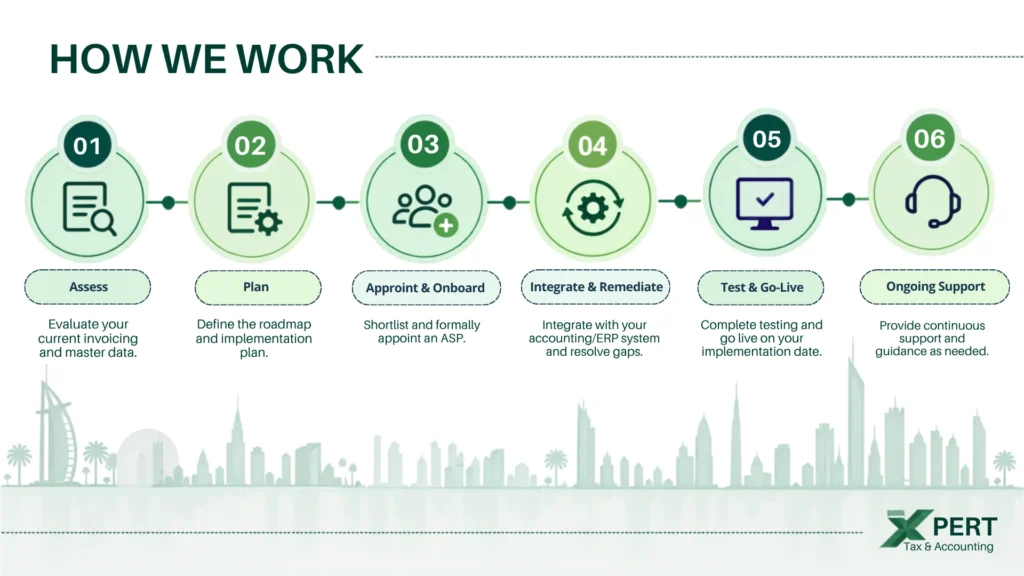
Stage 1: Assess

We thoroughly assess your systems, invoice-based scenarios, quality of data, and scope. You are then provided with a meticulous readiness report. 

Stage 2: Plan

We agree upon the sequence, shortlist a list of viable ASPs, and establish the dates that work in a backwards manner from your deadline.

Stage 3: Appoint & Onboard

You get into a sturdy contract with your selected provider; we aid the EmaraTax appointment. 

Stage 4: Integrate & Remediate

Your system gets connected, fields get mapped, and the data gets cleaned. 

Stage 5: Test & Go-Live

We validate transmission of invoices and handling of errors, train your team, and offer support throughout the switch process. 

Stage 6: Ongoing Support

Periodic reviews, monitoring of regulations, and impact evaluation when your system changes.

Xpert Tax & Accounting

Get Your E-Invoicing Readiness Evaluation Today!

The deadlines associated with e-invoicing are fixed and the work that stands in front of them is much lengthier than it appears to be. Let us know about your current invoice process and we will in turn let you know what actually stands between you and 100% compliance – which specific phase is applicable to your business, what exactly your current system can and cannot perform, and most importantly, what needs to be done and in what specific order.

Questions About UAE Corporate Tax

Frequently Asked Questions (FAQs)

Is e-invoicing compulsory in the UAE?

Yes. The E-Invoicing or Electronic Invoicing System is being introduced in multiple phases. Business entities with revenues of or exceeding AED 50 Million* must necessarily go live from 1st January, 2027, and business entities below the mentioned threshold from 1st July, 2027. Government entities will follow on 1st October, 2027. Since 1st July, 2026, the voluntary phase has been open. 

No. A PDF is deemed a static document. Similarly, so is a scanned copy, a Word file, or an emailed picture. A valid e-invoice in the UAE needs to be issued in the form of structured XML in the format of PINT AE and exchanged via an Accredited Service Provider. Emailing a PDF will not align with the requirement once your phase commences.

The procedure gets initiated via you through the EmaraTax portal of the Federal Tax Authority (FTA), and not by the provider. After agreeing terms commercially, you need to log in to the EmaraTax portal, navigate to the section of “e-invoicing,” choosing your selected provider, and going to their platform for completing the onboarding. Your details in EmaraTax need to be current before you begin.

It is dependent on your system as well as invoice volumes. However, the sequence – selection of provider, contracting, onboarding of EmaraTax, integration, cleanup of data, testing, as well as training – runs to numerous months for the majority of businesses and considerably much longer for groups with numerous entities or custom-made ERP setups.